
Before You Sign: The Car Title Mistakes That Delay a Donation
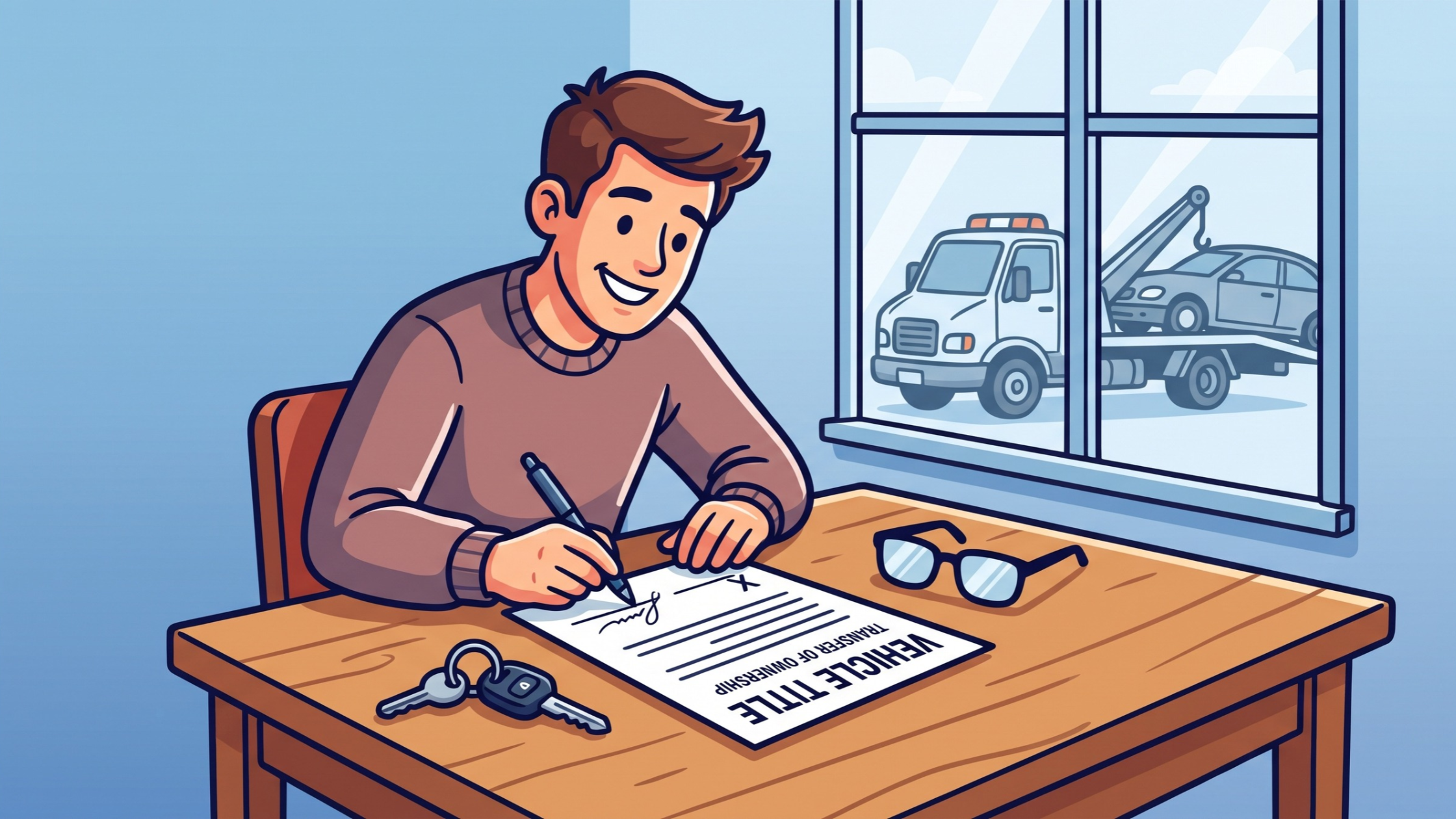
The title is the one document that proves you own the car, and one wrong mark can void it. Every state’s title looks different and deciphering each field can be overwhelming for first-time car donors. Field names, where you sign, and even whether you need a notary all change at the state line. We’re covering the universal rules, the state differences that trip people up most, and where to find a step-by-step video for your state.
The Universal Rules (They Apply in Every State)
From north to south, Atlantic to Pacific, these rules apply to all vehicle titles:
- Use blue or black ballpoint ink. Some states print it right on the title (West Virginia, South Carolina‘s “dark ink”). Skip pencil, marker, and gel pen as using these can void your title.
- Never correct a mistake. Nearly every title we reviewed says some version of “any alteration or erasure voids this title.” No white-out, no crossing out, no writing over. Call our team before you try to fix anything.
- Match the name on the front exactly. Your signature and printed name should match the owner line, middle initial and suffix included.
- Know the difference between printing and signing. Most states ask for both, in separate fields. Mixing them up is one of the most common errors.
- Leave the buyer and dealer sections alone. Reassignment blocks, purchaser applications, and buyer signatures belong to someone else.
Find Your Transfer Section (Front or Back?)
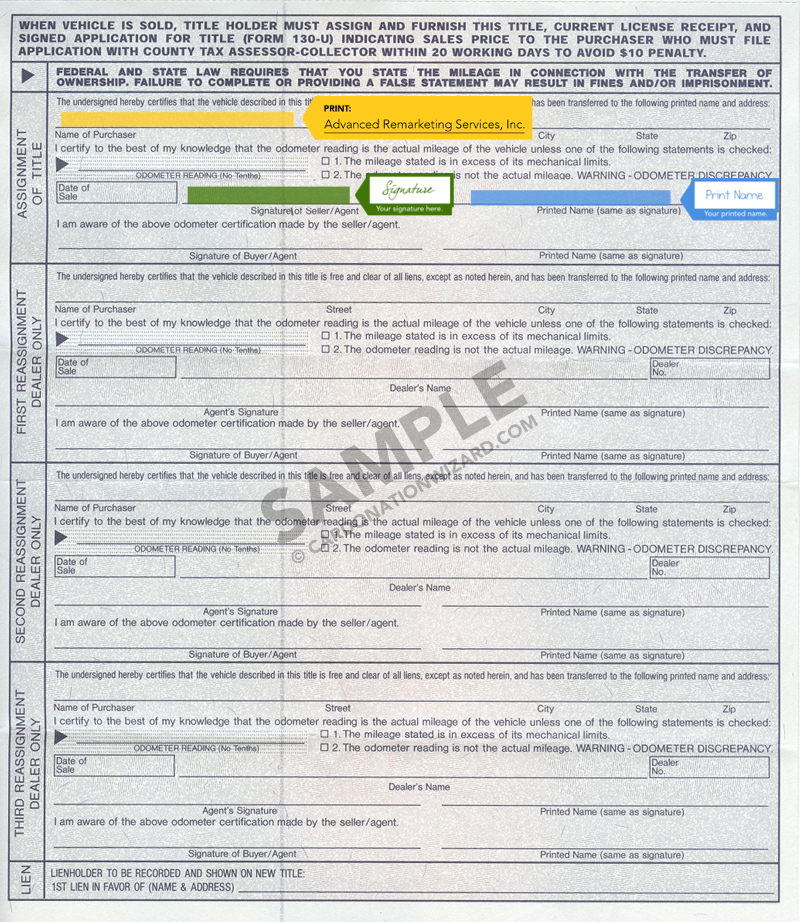
This is the section on your title where you’ll be filling out your information as the seller. In many states, the transfer section is on the back (California, Pennsylvania, Tennessee, Utah, and many more).
In other states, it’s on the front, and the back sections are reserved for dealers only. Examples: Illinois, Virginia, Wisconsin, and the most current Washington title format. Texas splits their transfer sections: one signature is on the front of the title, and one is on the back.
Our recommendation? Look for headings like “Assignment of Title,” “Transfer by Owner,” or “Assignment of Ownership.” Those are clear indicators that you’re looking at the transfer section of your title.
Does Your State Require a Notary?
Most states don’t, but a handful do, and signing before you’re in front of a notary can force you to start over and have to apply for a duplicate.
These states require signature notarizations on their titles:
Hawaii’s notary signatures are optional, but always double-check with your local DMV, Revenue Office, or Title Clerk to confirm if notarization is required for your title transfer.
Watch the order of operations when you’re notarizing your title. Some states, such as Pennsylvania, won’t notarize until the buyer’s name is filled in. When in doubt, leave the field blank until you are in front of the notary and have them confirm what they need to witness versus what you can fill in on your own before getting their seal and signature.
*Pennsylvania allows an authorized agent to verify instead of a notary, and Wyoming allows the county clerk to witness the signature.
Older Titles, Lost Titles, and States Without Titles
Our title help pages and videos include example title images for you to reference. However, many states have redesigned their titles over the years. If yours doesn’t match an online example, the field names may be different, not wrong. We highly recommend doing a quick online visit to your local title clerk website (don’t trust AI summaries, as they can provide outdated information) to see if they have examples you can reference.
If you’ve lost your title, most states offer a duplicate or substitute that you can apply for. For example, Washington offer’s an Affidavit in Lieu of Title that requires a notary signature but can be used if your Washington state title has been lost or destroyed.
Some states, such as Vermont, may not title older vehicles at all and allow owners to use their current registration. Check with your local title clerk to learn about your state’s rules.
Who’s the Buyer if You’re Donating Your Car?
When you aren’t actually selling the car, it can be tricky knowing whose name to print in the Buyer field of your title. Sometimes it’s the organization you’re donating to, and sometimes it’s the agency the organization is using to process the vehicle donations. The safest bet is to leave those fields blank until your donation team instructs you otherwise.
If you’re donating your vehicle to one of the charities featured on the Car Donation Wizard website, our title experts will give you explicit instructions for who to print as the buyer. You can call our team if you have any questions: 1-877-957-2277.
Car Donation Spotlight: 1990 Buick Reatta
Written By: Sam Andrews The 1988-1991 Buick Reatta was the company’s first attempt at an exclusive compact 2-door sports car since the 1940s. The Reatta will be remembered alongside similar vehicles offered around the same time by General Motors like the Cadillac...
The Truth About Car Donation to Charity
Scenario: It's got four wheels and an engine. Sometimes it even runs. But the mechanic's estimate is more than you want to pay, so it's time to get rid of the old clunker in your driveway. A 501(c)(3) public charity you like will take it off your hands. You'll dispose...
IRS Releases the Top Tax Scams for 2012
WASHINGTON –– The Internal Revenue Service today issued its annual “Dirty Dozen” ranking of tax scams, reminding taxpayers to use caution during tax season to protect themselves against a wide range of schemes ranging from identity theft to return preparer fraud. The...
Inspirational Car Donors: American Cancer Society
Earlier this week, as one of Car Donation Wizard's customer service representatives, I took a car donation on behalf of the American Cancer Society's Cars for a Cure® program. The donor called and began telling me that he and his wife had just had a cancer scare with...
Car Donation Spotlight of the Month: 1988 Sterling 825SL
Written By: Sam Andrews Among the great things that happened in the decades after World War II was the opening of free trade. Countries once at war were now peacefully trading with each other. The Germans and Japanese, formerly part of a coalition of our enemies...
How can you make sure your dollars are used effectively to support worthwhile causes?
Just as you would spend time chosing among personal investment options, it pays to put some effort into selecting among charities. "Most people aren't good about researching charities," said Chuck McLean, a vice president at GuideStar, an information service that...
Your Guide to Donating a Motorcycle to Charity
Donating a motorcycle to charity is not only easy, but it can benefit one of our great charitable organizations. We know that, as a vehicle donors, you have a lot of choices on where to donate your car or motorcycle to. Car Donation Wizard makes a pledge to its donors...
Car Donation to National Public Radio
At Car Donation Wizard, we are proud to be partnered with Car Talk's National Public Radio, giving donors easy access to donate a car to their favorite local radio station, anywhere in the country. All you need, in order to donate is the certificate of title and a...
Car Donation Tip: Ask how and where the money will be spent
This question should be easily answered. You should search for the charity or agency that makes the best use of the funds from your car donation. Beware of programs that promise to send proceeds to an organization without having a direct relationship. All charities...
Car Donation Spotlight: 1988 Merkur XR4Ti
By: Sam Andrews Quick: what was Ford Motor Company’s last spin-off brand in the United States? If you can’t remember, don’t blame yourself. The brand was named ‘Merkur’ and it only lasted two models during the final four years of the 1980s. Merkur’s brief time on this...